
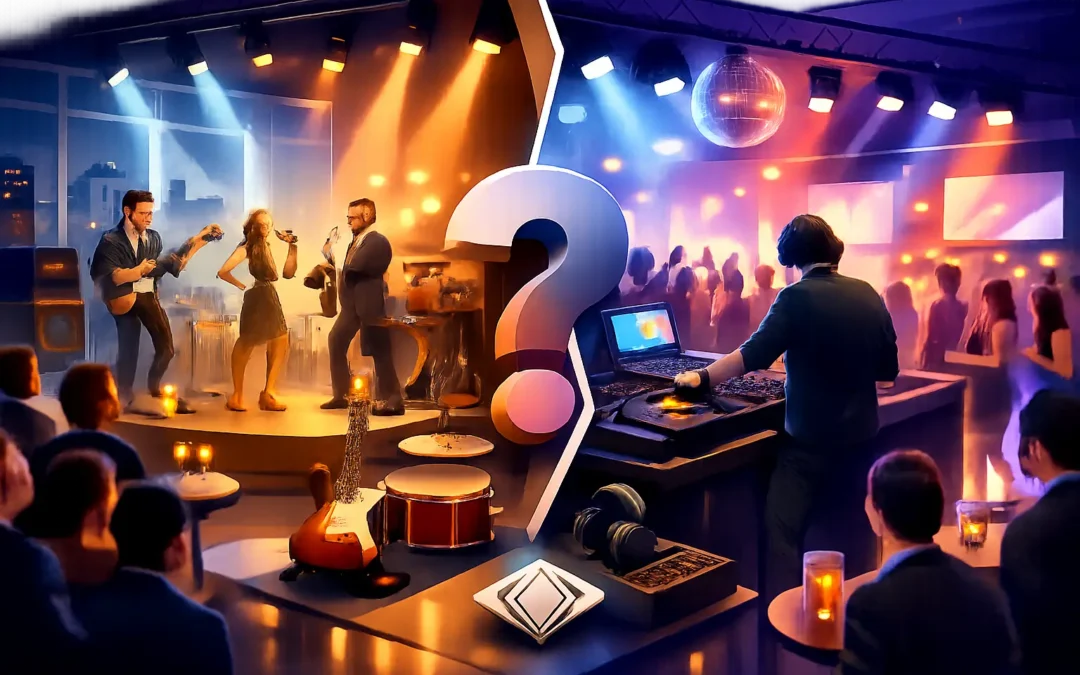
The room tells you fast whether you made the right entertainment call. If guests are drifting to the bar, checking phones, or heading out right after dinner, the music choice missed the mark. When people stay, loosen up, and actually get on the dance floor, that is not luck. It usually comes down to picking the right band or dj corporate event setup for the crowd in front of you.
This is where a lot of planners get stuck. A DJ feels flexible. A live band feels bigger. Both can work. Both can also fall flat if they are matched to the wrong kind of event.
Band or DJ corporate event: start with the outcome
Before you compare formats, get clear on what the event needs to do. Not what looks good on paper. Not what one executive liked at another company party five years ago. What does this room actually need tonight?
If the goal is background music for networking, a DJ often makes more sense. If the goal is to turn a holiday party, sales celebration, or company anniversary into a full-on shared experience, a live band usually has the edge. People react differently to live performance. It creates motion in the room. It gives people something to watch, not just something to hear.
That said, not every corporate event needs maximum volume and nonstop dancing. A leadership retreat welcome reception has different needs than a year-end party. An awards dinner may need elegant control early and a stronger push later. The best choice depends on how the event is structured, how mixed the crowd is, and how much energy you want in the room.
What a DJ does best at a corporate event
A good DJ brings range, speed, and control. They can pivot from Motown to Top 40 to early 2000s in seconds. They can keep volume lower during cocktails, handle walk-up music for awards, and stretch or cut songs to fit the timing of the program.
That flexibility matters when your event has a lot of moving pieces. If the schedule may shift, if there are several speakers, or if you need music across different moods in one night, a DJ can be a smart fit. They also typically require less space and a simpler setup, which helps in tighter venues or rooms with a lot of production already in place.
A DJ can also be the right move when your crowd is less dance-focused. Some corporate groups want a polished atmosphere, not a concert feel. If people are there mainly to mingle, catch up, and head home at a reasonable hour, a DJ can support the night without taking it over.
The catch is that DJs vary wildly. A great one reads the room and keeps things moving. A mediocre one becomes wallpaper. And if your event needs a real wow factor, a DJ may not create the same lift that a strong live act can.
Why a live band changes the room
When a live band is right, you feel it almost immediately. Guests look up. The room gets louder in the best way. A song everyone knows lands harder with real musicians, real vocals, and real interaction. At company events, that matters because many crowds start out guarded. Live music breaks that wall down faster.
A band also gives the event a more memorable identity. Anyone can rent speakers and queue up a playlist. A live act feels like entertainment, not just music service. That difference matters for holiday parties, milestone celebrations, client appreciation events, and any night where the company wants people talking about it afterward.
For mixed-age corporate crowds, a strong party band can be especially effective. One of the hardest jobs in event planning is finding entertainment that works for the 28-year-old sales rep, the 45-year-old department head, and the senior executive who wants to hear a song they actually recognize. A versatile live band can bridge those generations in a way that feels fun instead of forced.
That does not mean every band is the right fit. Some bands are great musicians but weak event partners. Some are too locked into one style. Some play for themselves instead of the room. For corporate work, the best bands understand pacing, crowd reading, clean execution, and how to shift from background elegance to packed dance floor without making the night feel disjointed.
The real trade-offs: budget, space, and flexibility
This is usually where the decision gets practical. A DJ is often the less expensive option upfront. A band usually costs more because there are more people, more gear, and more moving parts. If budget is tight, that matters.
But cost alone can be misleading. If entertainment is the thing guests will remember most, it should be weighted accordingly. Cutting corners on music to protect the budget can backfire if the event feels flat. On the other hand, paying for a large band at an event that only needs light energy is not efficient either.
Space matters too. Some corporate venues have limited stage area, difficult load-in access, or strict volume requirements. A DJ setup is easier to place and manage. A band needs more room, both physically and emotionally. If the room is tiny or the event is heavily speech-driven, a full live show can feel oversized.
Flexibility is the other big factor. DJs can often take requests on the fly and cover almost any genre. Bands bring a more curated experience. The strongest event bands still offer wide range, but they do it through performance, medleys, pacing, and smart song selection, not infinite catalog access. If your event needs exact versions of niche tracks throughout the night, a DJ may win there.
When the best answer is both
For many corporate events, the smartest answer is not band versus DJ. It is band and DJ.
This setup works especially well when the event has phases. A DJ can handle guest arrival, dinner, awards stings, and transitions. Then the live band takes over for the main party set. After that, the DJ can keep things going during breaks or close the night with a different vibe.
That hybrid approach gives you the impact of live performance and the flexibility of a DJ. It also solves a common planning problem – maintaining momentum from the first guest arrival through the final song. If the entertainment provider can handle multiple formats under one roof, even better. Fewer handoffs usually mean fewer headaches.
Questions that matter more than “band or DJ?”
The stronger question is, who can read a room and deliver under pressure?
Corporate events are not casual bar gigs. Timelines shift. VIPs run late. Speeches go long. The CEO suddenly wants a different intro. The entertainment has to adapt without making the event feel patched together. That is why experience in corporate settings matters just as much as raw talent.
Ask how the act handles mixed-age crowds. Ask how they build energy over the course of the night. Ask what happens if the schedule changes. Ask whether they can be polished during dinner and high-impact after formalities wrap. Those answers tell you more than a generic song list ever will.
If you are booking in markets like New York, New Jersey, Philadelphia, or Connecticut, that experience can matter even more. Event expectations are high, timelines are tight, and guests have seen plenty. You need entertainment that can impress without becoming difficult to manage.
How to choose with confidence
If your event needs efficiency, broad music access, lower footprint, and tight control over transitions, a DJ is probably the right call. If your event needs excitement, personality, and that full-room lift that gets people off their chairs, a live band is hard to beat.
If you want both impact and flexibility, combine them.
The best planners do not choose based on habit. They choose based on guest behavior. Will this crowd dance? Do they need a push? Is the event meant to feel elevated, relaxed, or all-out celebratory? Once you answer that honestly, the entertainment format gets a lot easier to choose.
A great corporate event is not just well organized. It feels alive. Pick the entertainment that gives your crowd permission to have a great time, and the rest of the night gets a whole lot easier.
Recent Comments