
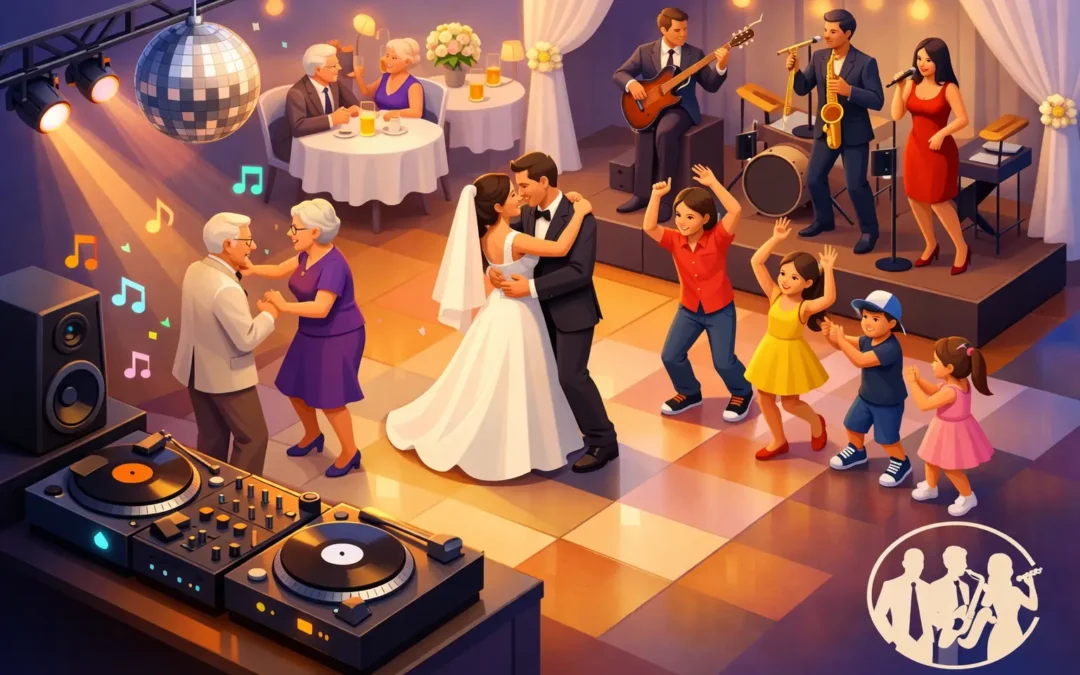
Picture the moment the dance floor opens. Your college friends are ready for a singalong, your parents want something they actually know, and your grandmother is giving the band one look that says, do not lose me in the first song. That is the real challenge with music for mixed generation weddings. It is not about pleasing everyone with background noise. It is about building momentum so different age groups feel pulled into the same party.
When wedding music works across generations, the room feels bigger, louder, and more connected. When it does not, the night can split in half. One group crowds the bar, another group leaves early, and the dance floor becomes a rotating shift change instead of a packed celebration. The fix is not playing it safe all night. The fix is knowing how to move between eras, energy levels, and singalong moments without breaking the vibe.
What makes music for mixed generation weddings tricky
A mixed-age wedding crowd usually wants the same thing in different packaging. Most guests are not asking for obscure deep cuts or a lecture in musical taste. They want songs they recognize, rhythms they can move to, and moments that feel fun instead of forced.
The problem is that a 28-year-old and a 68-year-old often hear “classic” very differently. One person means 2000s party hits. Another means Motown, disco, or rock standards. Add in a few guests who want country, a few who want 90s hip-hop, and one determined uncle who will absolutely request a seven-minute album version of something nobody can dance to, and now you have a real event decision on your hands.
That is why mixed-generation weddings need more than a playlist. They need pacing. They need transitions. They need a band or DJ who knows when to lean nostalgic, when to go current, and when to throw out a massive crossover hit that gets all ages singing the same chorus.
The best wedding sets do not play to one age group
A lot of couples make the mistake of building their music around themselves alone. It makes sense on paper. It is your wedding. But the best receptions are not private listening sessions. They are live rooms full of different personalities, comfort levels, and musical reference points.
If the set skews too young too early, older guests often check out fast. If it stays too traditional for too long, your friends may feel like the energy never really launches. Great music for mixed generation weddings hits both groups without making either one feel like an afterthought.
That usually means opening with broad appeal, not niche taste. Think songs that are instantly recognizable, easy to dance to, and familiar across decades. Once the floor is active, you can get more specific. The crowd will give you more room to stretch after they trust the entertainment to keep delivering.
How to build a set that keeps the room together
The strongest wedding music strategy starts with the idea that every set has a job. Early cocktail and dinner music should create warmth and anticipation. The first dance block should invite people in, not intimidate them. Later in the night, you can push the energy harder.
That first full dance set matters more than couples realize. If the opener is too aggressive, too current, or too musically narrow, you can lose half the room before the party gets rolling. A better move is to start with songs that bridge generations. That might mean upbeat soul, disco, 80s pop, 90s dance hits, or rock songs with hooks everyone knows by heart.
From there, variety wins. A strong live band knows how to go from Earth, Wind and Fire to Bon Jovi to Bruno Mars to a 90s throwback without making the night feel scattered. That range is what keeps a wedding from turning into separate mini-parties based on age.
Where couples usually get it wrong
One common mistake is chasing trends that look great online but do not play well in a real room. A song can be huge on social media and still land flat at a wedding if it does not have the right beat, hook, or familiarity. Weddings need reaction, not just relevance.
Another mistake is overloading the do-not-play list. Of course there are songs you never want to hear, and that is fair. But if the banned list is packed with every broad crowd-pleaser because it feels too obvious, you may end up stripping out exactly the songs that bring the room together.
The third mistake is treating all generations like fixed categories. Not every older guest wants slow songs. Not every younger guest wants club music. Plenty of parents want 80s rock. Plenty of twenty-somethings lose their minds for a Motown hit if the performance is right. The best approach is less about stereotypes and more about proven songs that create instant connection.
Live band energy gives mixed-age crowds an edge
There is a reason live entertainment can be such a strong fit for mixed-age weddings. A great band does more than play songs people know. It reads the floor in real time. It stretches the moments that are working, changes direction when needed, and gives familiar songs a shot of adrenaline.
That matters when you are trying to hold attention across age groups. Live vocals, real instruments, and strong emceeing can make a 70s dance hit feel just as exciting to younger guests as a current pop song. The reverse is also true. A modern hit performed with the right energy can pull in older guests who might ignore the original recording.
This is where experience matters. A seasoned wedding band understands that getting a packed floor is not about showing off musical taste. It is about timing, flexibility, and reading the room fast. That is the difference between a setlist that looks good on paper and a reception that actually explodes.
Songs that bridge generations best
The sweet spot is usually songs with one or more of these qualities: a big singalong chorus, a danceable groove, a famous opening riff, or a reputation as a guaranteed crowd starter. Those are the songs that cut across age lines because they ask less from the audience. People know what to do with them immediately.
Motown and soul are often gold because they feel timeless without feeling stale. Disco and funk work for similar reasons. 80s pop and rock can be huge, especially once the room is loose. 90s and 2000s party records often bring in younger guests while still feeling familiar to parents. Current songs can absolutely work too, but they usually play best when woven into a broader mix rather than dominating the whole night.
It also helps to think in waves. One set may lean more classic. The next can skew younger. Then you bring everyone back together with a massive crossover stretch. That approach feels intentional and keeps each age group engaged without turning the reception into a tug-of-war.
How to talk to your band about a mixed generation crowd
The best conversations are specific without being overly controlling. Instead of handing over a 150-song spreadsheet and hoping it all works out, tell your entertainment team what kind of room you want. Do you want black-tie polish with late-night party energy? Do you want lots of singalongs? Do you want your parents and their friends dancing early? Do you want a bigger 80s and 90s presence once the floor is hot?
This gives the band something useful to work with. It also leaves room for live adjustment, which is where the best event musicians earn their keep. If your crowd unexpectedly goes wild for old-school dance music, they can ride that wave. If your younger guests take over after dessert, they can pivot without losing the older crowd completely.
A good band will also help with the formalities. First dances, parent dances, introductions, and key announcements all affect the flow of the night. The stronger the pacing around those moments, the easier it is to keep guests engaged across generations.
The real goal is shared memories, not perfect balance
Couples sometimes chase a mathematically perfect split of decades and genres, but that is not how great wedding entertainment feels in the room. Guests remember whether they danced, sang, laughed, and felt part of something. They remember the floor being full. They remember hearing a song they did not expect and suddenly realizing everyone from cousins to grandparents was in on the same moment.
That is what music for mixed generation weddings should do. Not flatten the night into safe background sound, but build a party where different generations meet in the middle and stay there. If your entertainment can create that kind of momentum, the reception stops feeling like a schedule and starts feeling like the celebration everyone came for.
The smartest music choice is usually the one that gets the most people moving at once, because once the room is with you, everything gets easier from there.
Recent Comments