
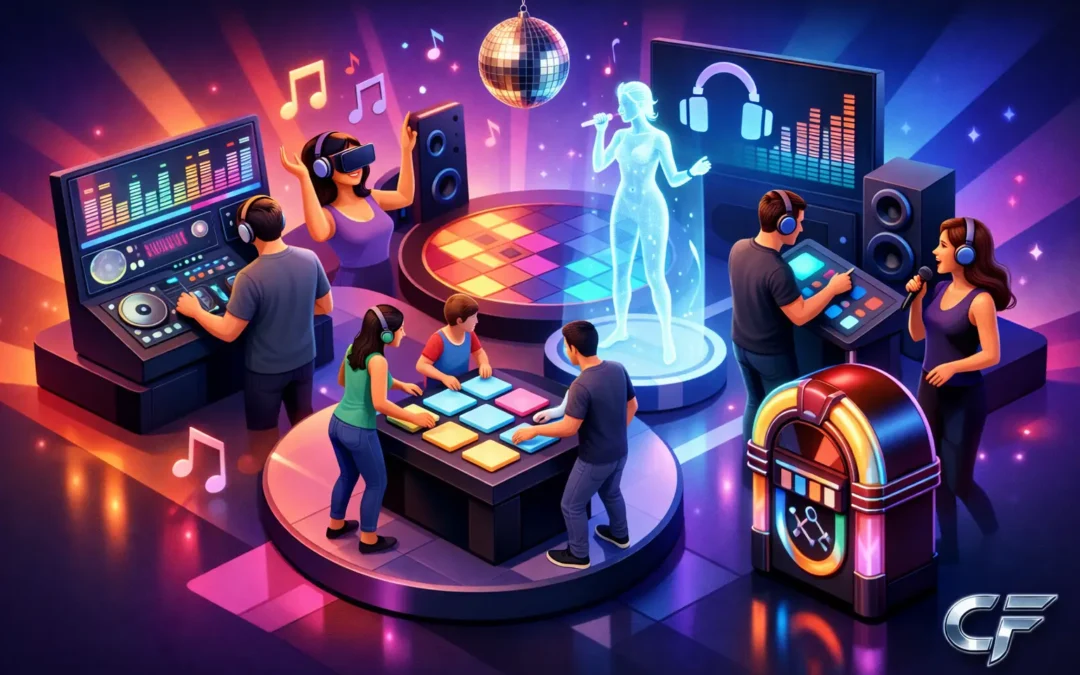
The moment a crowd stops watching and starts singing, choosing songs, answering trivia, or grabbing the mic, the whole event changes. Interactive music experiences for events do more than fill a room with sound – they give guests a reason to lean in, loosen up, and actually remember the night.
That matters because most hosts are not just booking music. They are trying to solve a bigger problem. They need a wedding that never loses steam, a corporate party that does not feel forced, or a venue night that keeps people around for another round. Great live entertainment can do that on its own, but the right interactive format takes it further by making the audience part of the momentum.
Why interactive music experiences for events work
A standard band setup can be fantastic when the setlist is strong and the room is ready to dance. But not every event starts there. Some crowds need a little invitation. Some are mixed in age, taste, or energy level. Some want a dance floor, while others want a more social format that still feels lively.
That is where interaction earns its keep. When guests are involved, the entertainment stops feeling like background and starts functioning like the engine of the night. People pay closer attention when they think their song might be next. They stay engaged when there is a game element. They commit faster when the performer makes the room feel included instead of observed.
There is also a practical side. Interactive formats help bridge transitions in an event. They can lift a cocktail hour that feels scattered, revive a post-dinner lull, or create structure during a company party where not everyone knows each other. For planners and hosts, that means fewer dead spots and less pressure to manufacture energy on their own.
The most effective interactive music experiences for events
Not every interactive idea works in every room. The best choice depends on the guest mix, event goals, and how much participation people will actually want. The sweet spot is usually entertainment that feels easy to join and never awkward to decline.
Live band karaoke
This format has a built-in thrill. Guests get the fun of karaoke, but instead of singing to a track, they perform with a real band. That changes the whole feel. It is bigger, looser, and far more exciting than standing in front of a machine in the corner.
Live band karaoke works especially well for corporate events, fundraisers, milestone birthdays, and private parties where the crowd wants a shared laugh and a few standout moments. It can be a headliner activity or a well-timed segment inside a larger live music set.
The trade-off is that it needs the right host energy and the right room. If the crowd is very reserved, the band has to guide participation carefully. A strong emcee makes all the difference here, because the format lives or dies on pacing and confidence.
Live music trivia
For groups that are social but not necessarily ready to dance at 7:30, live music trivia is a smart play. It gives guests something to do together without putting them on the spot individually. Add recognizable songs, quick rounds, and a charismatic host, and the room gets louder in the best way.
This format is a natural fit for corporate mixers, bars, breweries, community events, and rehearsal dinner weekends where you want energy without forcing a dance floor too early. It is also useful for mixed-age audiences because everyone can contribute from their own era. One table might know every 80s chorus. Another dominates 90s pop. That balance keeps the room engaged.
Song requests and audience-led sets
Sometimes the most effective interaction is the simplest. A band that can read the room and fold in audience requests creates a live feedback loop. Guests feel heard, and the set stays connected to what the room wants right now, not what looked good on paper three weeks earlier.
This is especially valuable at weddings and private events where the guest list spans generations. One crowd may light up for classic rock, another for 2000s pop, and another for funk, soul, or 90s dance hits. A flexible band can keep all of that in play without losing flow.
Of course, requests need boundaries. Taking every song suggestion can wreck pacing. The better approach is controlled spontaneity – enough flexibility to make the room feel part of the show, but enough discipline to keep the night moving.
Themed music nights and decade formats
Theme matters because it gives people permission to participate faster. An 80s night, 90s party, yacht rock set, or decade-spanning throwback show instantly gives the crowd a point of entry. They know what they are walking into, and that clarity boosts buy-in.
For venues, theme nights are strong because they are easy to market and easy for audiences to rally around. For private events, they create built-in personality. They also help guests connect with each other, because shared nostalgia is one of the fastest ways to get a room engaged.
The key is not to make the format feel gimmicky. The music still has to land. Costumes, visuals, and references can help, but the real driver is whether the songs are performed well enough to keep people dancing and singing along.
What makes an interactive format feel great instead of forced
The wrong kind of audience participation can get uncomfortable fast. Everyone has seen it – a host begging for volunteers, a game that drags, or a novelty act that gets more eye-rolls than applause. That is not an interaction problem. It is an execution problem.
Good interactive entertainment starts with strong musicianship. If the band cannot command the room musically, no amount of crowd work will save it. From there, timing matters. The audience should be invited, not cornered. A few well-placed moments often work better than constant interruption.
Pacing matters just as much. High-energy participation should build the night, not break it apart. At a wedding, that may mean keeping the dance set hot and using interaction in strategic bursts. At a corporate event, it may mean starting with trivia or singalongs before shifting into a full dance party. It depends on the goal.
There is also a logistics side that experienced entertainment teams think about early. How many microphones are needed? Where will participants enter and exit? Will the format work in a ballroom, a shore bar, or an outdoor tent? Can it be adjusted if the timeline shifts? The best interactive experiences feel spontaneous to guests because the behind-the-scenes details were handled in advance.
Choosing the right interactive music format for your event
If the goal is a packed dance floor, a high-energy live band with selective audience participation is often the strongest option. If the goal is team bonding, laughter, and easy engagement, live music trivia or karaoke may be a better fit. If the goal is venue traffic and repeat business, theme nights and flexible crowd-driven sets can be especially effective.
It also helps to be honest about your crowd. A black-tie wedding with a lot of reserved guests may not want ten people belting out karaoke. A rowdy birthday party might love exactly that. A corporate crowd may need an interactive opener before they fully commit to dancing. Matching the format to the room always beats chasing whatever sounds trendy.
This is where a multi-format entertainment group has a real advantage. When a band can shift between dance sets, themed programming, trivia, and live band karaoke, the event does not have to be squeezed into one lane. The entertainment can be built around what the crowd will actually respond to.
For planners and hosts in New York, New Jersey, Philadelphia, and Connecticut, that flexibility can be the difference between a night that simply runs on schedule and one that catches fire. Rooms change. Timelines move. Guest energy rises and falls. Entertainment that can pivot in real time is worth a lot.
The best events are not remembered because the playlist looked good on a proposal sheet. They are remembered because the room felt alive. If you want guests to do more than sit, sip, and scroll, interactive music gives them a reason to jump in – and that is when the party really starts.
Recent Comments