
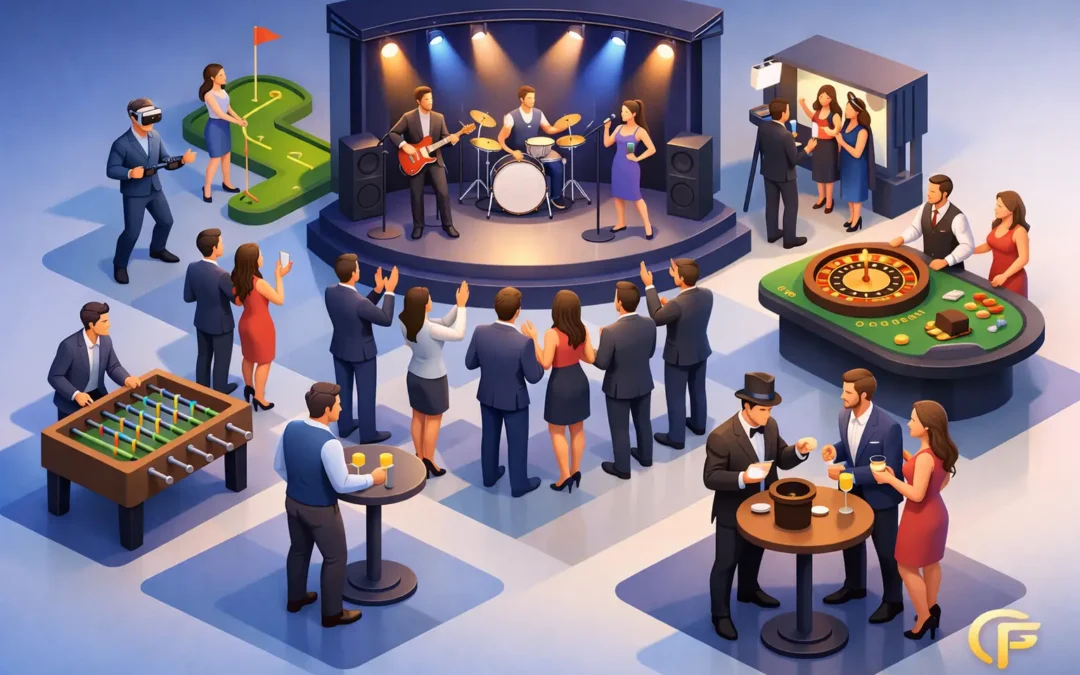
The fastest way to lose a corporate crowd is to treat entertainment like background wallpaper. If you want to know how to entertain corporate event guests, start with one truth: your audience is not one audience. It is executives, new hires, top clients, introverts, extroverts, plus-ones, and people who came ready to dance standing next to people who would rather stay by the bar and talk.
That mix is exactly why corporate entertainment has to do more than fill silence. It has to shape the night, lift the energy without forcing it, and give people a reason to stay engaged from the first drink to the final song. When it works, the room feels easy. People connect, the event has momentum, and guests leave talking about it instead of slipping out early.
How to entertain corporate event guests starts with the room
Before you book anything, look at the actual job the entertainment needs to do. A holiday party has different energy than a sales kickoff. A client appreciation event needs a different touch than an employee celebration. The right choice depends on whether you want people networking, participating, dancing, or moving between all three.
This is where a lot of planners get tripped up. They book one entertainment format and expect it to carry the entire night. Sometimes that works. More often, it creates a mismatch. A full dance set at the start can overpower cocktail hour. Quiet background music at 9:30 can flatten a crowd that is ready for something bigger.
A better approach is to think in phases. Early on, guests need space to arrive, settle in, and talk. Mid-event, they need a clear lift in energy. Later, they need something memorable that turns the event from pleasant to genuinely fun. Entertainment should follow that arc.
Match the entertainment to the crowd, not just the budget
Corporate planners often ask what is “best” for entertaining guests. The honest answer is that it depends on who is in the room.
If your guest list spans multiple age groups, niche entertainment can be risky. A broad-format live band usually plays better because recognizable songs pull in more people, faster. Familiar hits remove friction. Guests do not have to figure out whether they like the act. They already know the music, and that lowers the barrier to participation.
If your event is more interactive by design, you may want entertainment that breaks the wall between performer and audience. Live band karaoke, music trivia, or an emcee-driven format can be a smart move when your goal is involvement, not just applause. These formats work especially well for company culture events where the crowd wants to laugh, compete, and loosen up together.
If your event is heavily client-facing, the safest play is often polished live music with strong crowd reading. You want energy, but not chaos. You want something impressive, but not self-indulgent. That balance matters. The entertainment should elevate the brand in the room, not distract from it.
Why live music works so well at corporate events
There is a reason live music keeps outperforming passive entertainment. It reacts in real time.
A great live act can read the floor, adjust tempo, shift genres, extend the right moment, and pull back when guests need breathing room. That flexibility is huge at corporate events because these crowds rarely behave in a straight line. They warm up slowly, then all at once. They may need a few familiar songs before the dance floor opens. They may respond better to a singalong than a showy solo.
That is the difference between entertainment that looks good on paper and entertainment that actually lands in the room. A strong band is not just playing songs. It is managing momentum.
For mixed corporate crowds, this matters even more. You need music people in their 30s, 40s, 50s, and 60s can all recognize without making the night feel stale. You need pacing that can support networking and then flip into party mode. You need a level of professionalism that fits a black-tie gala but still brings a real pulse to the event.
Build the night around energy changes
One of the best answers to how to entertain corporate event guests is to stop thinking of entertainment as a single booking and start thinking of it as event flow.
Cocktail hour should invite conversation. Dinner should support the room, not compete with it. After formalities, the energy should noticeably rise. Once guests feel that shift, they are much more likely to engage, stay longer, and remember the event as a success.
That does not mean every corporate event needs a packed dance floor from minute one. In fact, forcing that too early can backfire. The best events earn their big moments. They give guests time to arrive socially before asking them to participate publicly.
This is where experienced entertainment makes a major difference. A band or entertainment team that knows corporate events will understand transitions. They will know how to handle announcements, timing changes, award segments, and the occasional last-minute schedule adjustment without killing the mood.
Give guests more than one way to have fun
Not every guest wants to dance, and not every guest wants to sit still. Good corporate entertainment gives people options.
That might mean live music that is dynamic enough for the dance floor but controlled enough for conversation around the edges. It might mean adding a themed set that sparks nostalgia without taking over the event. It might mean a trivia segment before the party set begins, or live band karaoke later in the night when people are ready to jump in.
The key is range. When entertainment can shift formats, you avoid the usual problem of appealing strongly to one slice of the room while losing everyone else. Guests should feel like the event has layers. Even if they never grab a mic or hit the dance floor, they should still feel part of the action.
That is especially important at company events where attendance is not always entirely voluntary. Some guests arrive excited. Some arrive because it is on the calendar. Smart entertainment wins over both groups.
Don’t let production mistakes sink good entertainment
Even the strongest act can struggle if the setup is wrong. Room layout, sound level, staging, and timing all shape guest experience more than many planners realize.
If the band is crammed into a corner with no visual presence, the entertainment feels smaller. If the volume is too high during dinner, guests get annoyed before the party even starts. If there is no open space near the stage or dance floor, guests are less likely to engage.
This is one place where working with experienced event entertainment pays off. Professionals know how to scale the setup to the room, manage sound for different phases of the night, and coordinate with planners so the event feels polished rather than patched together.
For corporate events in markets like New York, New Jersey, Philadelphia, and Connecticut, where guest expectations can run high and schedules are tight, that kind of reliability matters. The room has to look good, sound good, and move on cue.
How to entertain corporate event guests without making it feel forced
The biggest mistake at corporate events is trying too hard to manufacture fun. Guests can feel that immediately.
Entertainment should create openings, not pressure. A strong emcee can invite participation without turning the night into a mandatory team-building exercise. A great live band can pull people in naturally by playing songs they already want to hear. A themed set can trigger nostalgia without making the event feel cheesy.
The sweet spot is confidence without pushiness. Guests should feel like they are stepping into a good time, not being ordered to have one.
This is why crowd awareness beats novelty for novelty’s sake. Flashy acts can get attention, but attention is not the same as connection. The entertainment that works best at corporate events usually has broad appeal, crisp execution, and enough flexibility to pivot as the room changes.
What planners should prioritize when booking entertainment
If you are choosing between options, ask practical questions. Can the act handle mixed-age crowds? Can they adjust for cocktail hour, dinner, and high-energy dancing? Do they know how to work with event timelines and corporate formalities? Can they offer more than one format if the night needs variety?
The strongest entertainment partners are not just talented. They are dependable. They understand pacing, professionalism, and the fact that your event is bigger than their performance. That is a huge part of guest satisfaction. People remember the fun, but planners remember whether the entertainment made the night easier or harder to run.
A band like The Counterfeiters stands out in this space because format flexibility matters. When one entertainment team can shift from polished live music to a themed set, live band karaoke, or music trivia, you get more control over the room without juggling multiple vendors. For a corporate planner, that is not just convenient. It is strategic.
The best corporate events do not happen by accident. They are built around timing, crowd reading, and entertainment that knows when to lead and when to support. If you want guests talking, laughing, singing, dancing, and actually staying to the end, give them something that feels alive. People may come for the company event, but they remember the night that felt like a real party.
Recent Comments