
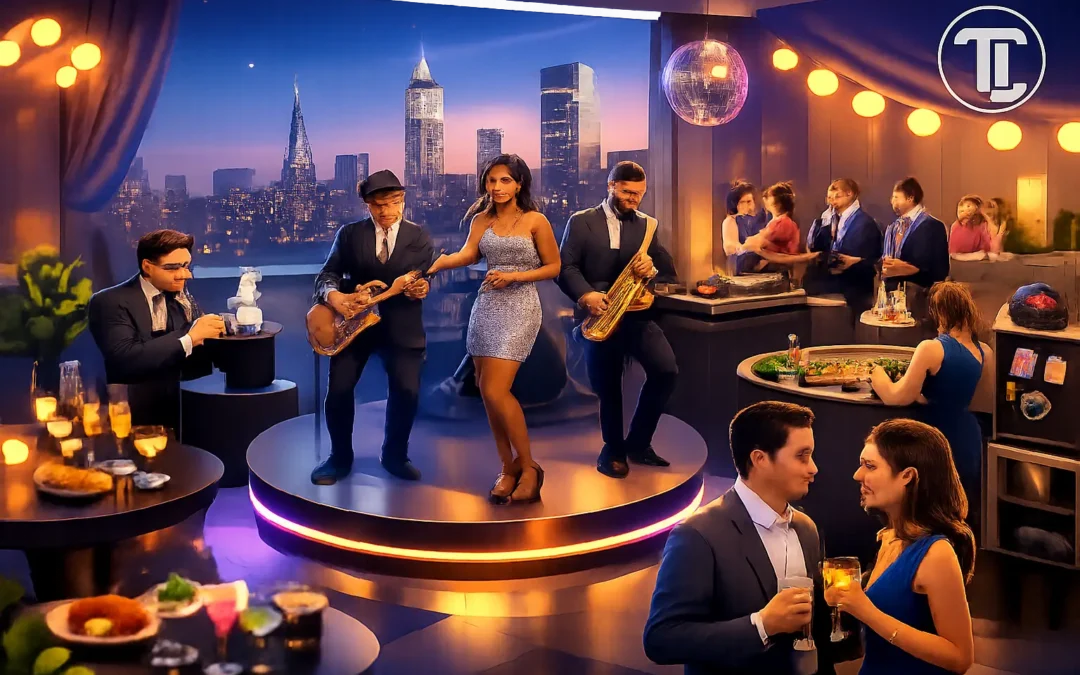
A corporate party in New York has one job once the doors open – get people out of work mode and into the room. That sounds simple until you realize your guest list includes executives, new hires, clients, plus-ones, and people who would rather talk near the bar than hit the dance floor. Great New York corporate party entertainment bridges that gap fast. It changes the energy, gives the night a pulse, and makes the event feel like more than another date on the calendar.
That is why entertainment is rarely just a line item. It is the part guests remember when they decide whether the event felt flat, forced, or genuinely fun.
What New York corporate party entertainment needs to do
In a market like New York, expectations are high and attention spans are short. Guests have been to rooftop mixers, black-tie galas, holiday blowouts, and trendy launch parties. If the entertainment feels generic, the room knows it right away.
The best entertainment does three things at once. First, it creates instant familiarity. People respond to songs, formats, and moments they recognize without needing an explanation. Second, it gives the night structure. A strong act can build momentum from cocktails to dinner to full-on party mode instead of making the evening feel chopped into disconnected segments. Third, it works for a mixed crowd. That matters at corporate events more than almost anywhere else.
This is where a lot of planners get stuck. They know they need energy, but they also need polish. They want something exciting, but not chaotic. They want broad appeal, but not background music that disappears. The answer usually is not more complexity. It is better programming.
Why live entertainment usually beats passive entertainment
There is a reason live bands, interactive music formats, and experienced event entertainers keep winning corporate work. A live act reads the room in real time. If the crowd is slow to warm up, the show can pivot. If the dance floor opens early, the set can lean into it. If the audience skews older, younger, more formal, or more ready to let loose, the performance adjusts.
A playlist cannot do that. Neither can a novelty act that feels fun for ten minutes and forgettable by dessert.
Live entertainment also changes the perception of the event itself. It signals effort. It tells guests this was planned with intention, not assembled from safe defaults. For internal company events, that can improve attendance and participation. For client-facing events, it sharpens the brand experience. For holiday parties, anniversaries, and milestone celebrations, it turns a nice evening into a night people actually talk about later.
That does not mean every event needs a full dance set from start to finish. It depends on the room, the goals, and the schedule. Sometimes the right move is a band that starts sophisticated and builds into a packed dance floor. Sometimes it is live band karaoke, music trivia, or a themed format that gives people an easy way in. The point is not to force one style onto every event. The point is to choose entertainment with range.
Choosing entertainment for the event you are actually hosting
This sounds obvious, but many corporate events are booked around a vague goal of wanting something fun. That is too broad to be useful.
Start with the type of response you want from guests. If you are hosting a holiday party, you probably want release, excitement, and strong end-of-night energy. If it is a networking event, you may want music that supports conversation early and grows bigger later. If it is an awards dinner, the entertainment has to respect timing, speeches, and transitions while still delivering a payoff.
Venue matters too. A ballroom can handle a bigger production and a wider arc across the night. A rooftop may need tighter staging and a more controlled volume strategy. A restaurant buyout needs entertainment that can energize the room without swallowing every conversation. Good performers know the difference. Great ones plan for it before load-in.
Then there is the audience itself. Corporate crowds are almost always mixed in age, role, and personality. That is why niche entertainment can be risky unless the event is built around that concept. A broad, recognizable setlist usually wins because it brings more people in. The same goes for themed experiences. An 80s or 90s angle can be a blast if the crowd is ready for it, but it works best when it still leaves room for cross-generational hits that keep everyone involved.
The entertainment formats that get the best reaction
For most corporate events, high-energy live music remains the strongest all-around choice because it covers the most ground. It can be polished during cocktails, sharp and controlled during formal programming, and explosive once the dance floor opens. That flexibility is hard to beat.
Interactive formats deserve more attention than they usually get. Live band karaoke works because it turns guests into part of the show without putting pressure on everyone to participate. Music trivia can be a smart fit for company events that want engagement before the party shifts into a more social rhythm. Decades nights and themed sets also work well when the company wants the event to feel distinct rather than interchangeable with every other annual gathering.
The trade-off is that specialty formats need confident execution. If they are treated like gimmicks, they can stall out. If they are run by seasoned entertainers who know how to move a room, they become the thing people keep talking about.
What separates a great entertainment partner from a decent band
Song list matters, but it is not enough. Plenty of groups can play recognizable songs. Fewer know how to pace an event, manage transitions, read a corporate crowd, and keep the energy climbing without overselling every moment.
Professionalism is where the difference shows. A strong entertainment partner communicates clearly before the event, coordinates with planners and venues, arrives prepared, and understands that timing is part of the performance. They know when to stretch, when to tighten, and when to let the room breathe. They can be fun without being sloppy and polished without feeling stiff.
That balance matters a lot in corporate settings. The room may include leadership, clients, and guests who all have different thresholds for what feels appropriate. You want a performance that feels alive, not reckless. Big energy is great. Control is what makes it land.
This is also why experience across different event types matters. A group that has only played bars may not understand the rhythm of a gala. A group that only does formal events may struggle to open up a crowd that wants a real party. The sweet spot is an act with range – one that knows how to handle black-tie rooms, casual celebrations, themed events, and everything in between. That is the difference between playing songs and running the night.
How to make your entertainment budget go further
The cheapest option is often expensive in all the wrong ways. If the entertainment falls flat, the whole event feels flatter. Guests leave early, participation drops, and the atmosphere never recovers.
A better question is what kind of value you are buying. Are you getting one-note background music, or are you getting a full evening driver that can support multiple phases of the event? Are you hiring performers who need heavy direction, or a team that can help shape the flow? Are you booking something that works for one narrow segment of guests, or one that brings the whole room together?
When the entertainment is right, it reduces pressure on everything else. The crowd stays engaged. The transitions feel smoother. The event gets more mileage out of the venue, the catering, and the planning work already invested. That is real value.
For planners who want a safer bet, versatility usually beats novelty. A band or entertainment company that can customize set structure, adjust tone, and offer multiple formats gives you options if the room shifts. That matters in New York, where no two corporate events feel exactly the same and the crowd can change the mood of the night in minutes.
New York corporate party entertainment should feel like a payoff
Guests can tell when entertainment was booked just to fill space. They can also tell when it was chosen to give the night a real spark. The difference shows up in body language first. People linger. Then they move closer. Then the room gets louder, looser, and more connected.
That is the goal. Not just music. Not just noise. A party that earns its own momentum.
If you are planning a corporate event, think beyond whether the entertainment looks good on paper. Ask whether it can carry a mixed crowd, adapt to the room, and create the kind of energy that makes the night worth attending in the first place. When it can do that, you are not just booking a band. You are giving the event its turning point.
And that is usually the moment people remember on the ride home.
Recent Comments