
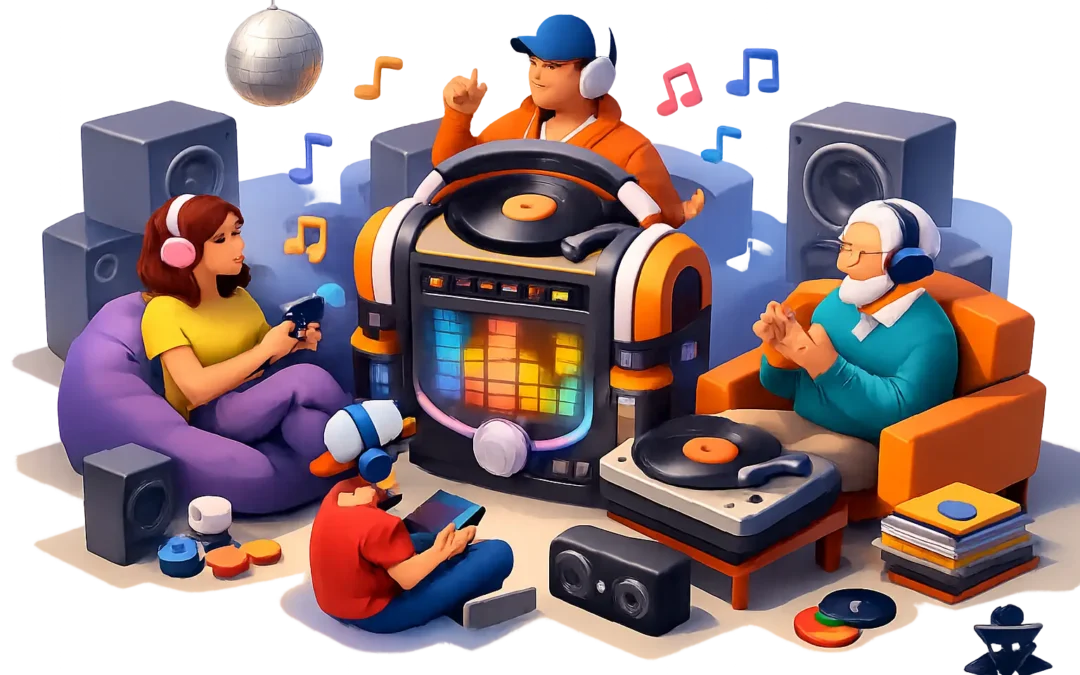
A packed dance floor at 9:30 can disappear by 10 if the music starts leaning too hard in one direction. Play nothing but current hits, and the older crowd checks out. Stay locked in classic rock all night, and younger guests head for the bar. If you’re asking what music works for mixed generations, the answer is not one genre, one decade, or one safe playlist. It’s a smart mix of familiarity, timing, and momentum.
That matters whether you’re planning a wedding, a corporate party, a fundraiser, or a bar event with a broad age range. Mixed-generation crowds do not want the same thing every minute, but they do respond to the same feeling – songs they recognize, moments they can join, and a flow that keeps the room moving instead of splitting it.
What music works for mixed generations at an event?
The short answer is recognizable, upbeat music from multiple eras, played in the right order. The longer answer is where the real event planning lives.
When a crowd spans late 20s to 60s, the win is not trying to make every guest love every song. The win is making sure every group gets pulled in often enough that the room stays connected. That usually means building around big crossover songs – tracks with broad recognition, strong hooks, and a beat people can move to even if they would never call it their personal favorite.
Think of the songs that cause a reaction within the first three seconds. A great chorus helps. A familiar intro helps even more. Guests do not need deep cuts at a mixed-age event. They need songs that make them say, “Oh, I know this one,” and then stay where they are instead of wandering off.
The best music for mixed generations starts with recognition
Recognition beats niche taste almost every time in a room full of different ages. That does not mean the music has to be bland. It means the songs need enough shared cultural mileage to land fast.
Motown, disco, 80s pop, 90s dance, early 2000s singalongs, and select current hits tend to do the most work because they cover multiple comfort zones at once. A Bruno Mars track can pull in younger guests while still feeling familiar to older ones. Earth, Wind & Fire can fill a dance floor with people who were there the first time around and people who just know it works. Journey, Whitney Houston, Prince, Madonna, Bon Jovi, Usher, Kelly Clarkson, and Outkast all have songs that bridge age gaps better than trendier picks that burn hot for six months and then disappear.
This is why broad appeal matters more than personal playlist logic. A song can be a hit and still be wrong for a mixed crowd if it is too sleepy, too polarizing, or too tied to one age group. On the flip side, a song someone would never stream on their own can become a huge event moment because it creates instant group energy.
Energy matters more than genre
One of the biggest mistakes in mixed-generation planning is overthinking style and underthinking energy. Guests are not standing around categorizing the night by genre. They are reacting to pace, familiarity, and whether the room feels alive.
A great event can jump from 80s rock to 90s hip-hop to modern pop to classic soul if the transitions make sense and the energy keeps climbing. A bad event can stay inside one genre all night and lose people because every song sits in the same lane.
That is why live bands and experienced DJs who read a room consistently outperform static playlists. A mixed crowd needs adjustment in real time. If the dance floor spikes on a throwback medley, you keep feeding that lane. If the younger guests flood in after a newer dance track, you do not immediately slam the brakes with three slow songs. The room tells you what it wants, but only if you are paying attention.
The strongest setlists mix decades, not just songs
If you want to know what music works for mixed generations, start by thinking in waves. The best nights do not segment the audience by age. They rotate through eras in a way that keeps everyone involved.
Early in the event, it helps to stay welcoming and wide. Soul, pop classics, lighter rock, and easy-recognition favorites create common ground while people settle in. As the night builds, you can get bolder. This is where 80s dance, 90s party hits, 2000s pop, and modern crowd-pleasers start trading off. Later, when the room is fully bought in, big singalongs and high-impact dance tracks usually win.
There is a rhythm to this. Older guests often want familiarity first. Younger guests usually respond once the energy gets sharper and the beat gets heavier. But those are not hard rules. Plenty of 30-somethings go wild for 80s anthems, and plenty of guests in their 50s want to hear 90s hip-hop. The point is not to stereotype the room. It is to avoid programming that only serves one slice of it for too long.
Songs that usually work – and songs that need caution
Some songs are event glue. They pull people from different generations onto the same floor because the chorus is huge, the rhythm is obvious, and the mood is fun. Think “September,” “I Wanna Dance with Somebody,” “Billie Jean,” “Shut Up and Dance,” “Mr. Brightside,” “Uptown Funk,” “Don’t Stop Believin’,” and “Yeah!” These are not obscure choices, and that is exactly the point.
Other songs need a little caution, even if they are popular. Tracks that are too explicit, too slow for too long, too regionally specific, or too locked into one subculture can thin a broad crowd fast. The same goes for songs that feel more like a private favorite than a public party record. A mixed-generation event is not the place to prove how interesting your music taste is. It is the place to keep the room together.
That also applies to novelty songs. One or two can create a fun release. Too many and the night starts to feel like a joke instead of a party. Guests want excitement, not gimmicks.
Live performance changes the equation
Recorded playlists can get you through a gathering. A strong live band can turn it into an event people talk about afterward.
That is especially true with mixed-age crowds, because live performers can shape the material to the room. A great band can tighten the transitions, stretch the songs people are loving, shorten the ones that are not landing, and connect generations through delivery. A 70s classic can feel fresh. A current hit can feel more universal. The result is not just a list of songs. It is a shared experience.
For weddings and corporate events, that flexibility matters. You are not just filling time. You are managing energy across cocktail hour, dinner, and peak dance-floor time, often for a crowd that includes coworkers, college friends, parents, uncles, and clients in the same room. That is where experience pays off.
How to choose music for a mixed-generation crowd
Start with the people, not the playlist. Who has to feel included? At a wedding, that may mean balancing the couple’s favorites with songs that pull in parents and family friends. At a corporate event, it may mean steering away from anything too risky and leaning into songs everybody can recognize within seconds.
Next, be honest about the goal. Is this a dance-heavy party or a social event with dance moments? Those are different jobs. If dancing is the priority, choose more upbeat songs with strong hooks and fewer genre detours. If conversation matters too, you can widen the range earlier and save the heaviest hitters for later.
Finally, trust sequencing as much as song choice. Even great songs can fail if they arrive at the wrong time. A room full of guests finishing dinner is not ready for an all-out peak-hour banger. A dance floor that is finally exploding does not want a sudden reset. Good music selection is part taste and part timing.
That is why experienced event entertainment tends to outperform DIY curation. It is not just about owning a long song list. It is about knowing when to pull from which decade, when to lean nostalgic, when to go current, and when to hit the giant chorus everybody will scream back.
For mixed-generation crowds, the sweet spot is familiar, energetic, and flexible. Give guests songs they know, spread the love across eras, and keep the night moving forward. If the room feels united instead of divided by age, you picked the right music.
Recent Comments