
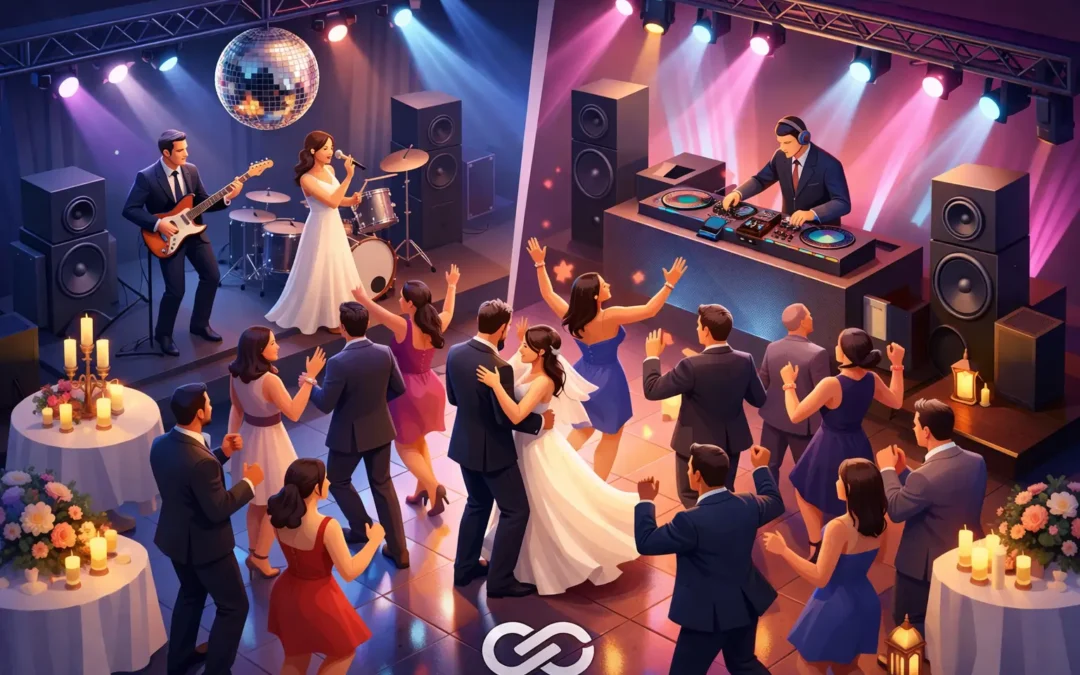
The live band or DJ wedding decision usually comes down to one moment: the first time you look across the room and see your favorite people either racing to the dance floor or staying planted at their tables. Music is not background noise at a great reception. It sets the pace, changes the mood, and gives guests a reason to stay until the last song.
A DJ and a live band can both throw an unforgettable party. The right choice depends on the kind of energy you want, the size and mix of your guest list, your venue, and how much you value a performance that feels completely alive in the room.
Live Band or DJ Wedding: Start With the Party You Want
Before comparing packages and song lists, picture the reception in motion. Do you want a polished club-style flow where every original recording is available on demand? Or do you want the rush of a real band building a song, working the crowd, and turning a familiar hit into a full-room singalong?
A DJ is often the best fit for couples who want a huge catalog, specific original versions of songs, and a smaller entertainment footprint. A strong DJ can read the room, move from current pop to throwbacks quickly, and accommodate highly specific requests.
A live band brings a different kind of impact. There is something immediate about seeing musicians perform the songs everyone knows, trading energy with the dance floor and making the room feel like a concert built around your guests. For couples planning a celebration that feels big, social, and high-energy, that difference matters.
The answer is not that one is automatically better. It is that each creates a different party.
Why a Live Band Changes the Room
A great wedding band does more than play songs accurately. It gives the night a pulse. The lead singer can call guests to the floor, the rhythm section can stretch a chorus when the room is singing at full volume, and the entire group can shift its intensity in real time. That kind of interaction is hard to duplicate with a playlist, no matter how good the playlist is.
Live music also creates visual excitement. Guests do not just hear the entertainment. They watch it happen. That is especially valuable during a reception’s key transition points: the grand entrance, first dance, parent dances, the first open-dance set, and the final stretch when you want everyone out of their seats.
For mixed-age weddings, a versatile party band can be a major advantage. The right setlist can move from Motown and classic rock to 80s anthems, 90s throwbacks, country favorites, and current dance hits without losing momentum. The goal is not to prove how cool your music taste is. The goal is to play songs that make your college friends, parents, coworkers, and fun uncle all feel like the next song might be theirs.
That range is where experienced bands earn their keep. They know when to play the song every guest expects and when to hit the unexpected favorite that brings a new group to the floor.
The trade-off: cost, space, and song versions
Live bands generally cost more than DJs because you are hiring multiple professional performers, production, and the experience required to run a major event. They also need room for musicians, equipment, and a proper sound setup. If your venue has a tiny reception space or tight sound restrictions, those details deserve attention early.
You also will not get every song in its original studio form. A band can deliver a great version of a song, but it will be their live version. For some couples, that is the whole point. For others, hearing a specific recording exactly as they remember it is a priority.
When a DJ Is the Smart Call
A DJ can be an excellent wedding choice, particularly when flexibility is the top priority. If your must-play list includes niche tracks, multiple genres, international music, or songs that are difficult for a band to recreate, a DJ has the catalog advantage. They can also pivot fast. One minute can be hip-hop, the next can be disco, followed by a current pop track with no pause between songs.
A DJ may make more sense for a smaller wedding, a venue with limited space, or a budget that needs to cover several other priorities. It can also work well for couples who want a late-night set that leans heavily into electronic music, dance remixes, or original recordings.
But a DJ’s success is not automatic. The person behind the booth matters just as much as the equipment. Ask how they handle announcements, requests, pacing, and guests who want wildly different things. A DJ who simply presses play can leave a room flat. A skilled entertainer knows how to build a dance floor gradually and keep it full.
Consider the Guest List Before the Genre List
Couples often start with their own favorite artists. That is understandable, but your reception is one of the few parties where several generations are expected to celebrate together for hours. Your guests do not need to love every song. They do need enough familiar moments to join in.
A live band is particularly powerful when your goal is broad appeal. The best party bands are not locked into one decade or one sound. They shape the night around the room, playing recognizable hits that work for the entire crowd rather than treating the reception like a personal playlist.
If your guests are mostly close friends in the same age range and share a narrow music taste, a DJ may give you the precision you want. If your guest list includes everyone from grandparents to coworkers to friends who still know every word to a 90s hit, live performance often brings people together faster.
Budget for the Full Experience, Not Just the Act
When comparing a live band and DJ, look beyond the headline price. Ask what is included: ceremony music, cocktail-hour music, microphones for speeches, lighting, sound production, setup time, break music, and the number of performers. A lower initial quote can change quickly when essential pieces are added later.
For a live band, ask whether the group provides a dedicated sound engineer and how they handle breaks. Professional bands typically keep the energy moving with curated music between live sets, so guests are not left wondering where the party went. Ask about the band’s arrival time, stage requirements, power needs, and backup plan for illness or weather if any portion of the event is outdoors.
For a DJ, ask about backup equipment, ceremony coverage, wireless microphones, lighting, and whether the person you meet is the person who will actually perform at your wedding. These are not glamorous questions, but they protect the party.
The Best Questions to Ask Before Booking
The fastest way to separate dependable entertainers from a risky gamble is to ask how they run a wedding, not just what songs they know. Find out how they read the crowd, handle requests, manage volume for dinner and speeches, and coordinate with your planner or venue.
For a band, ask to see a sample setlist and find out how much flexibility they have on the night. Can they learn a first-dance song? Can they provide a smaller cocktail-hour format? How do they build from dinner music into a packed dance floor? For a DJ, ask how they avoid abrupt genre changes and how they respond when the dance floor starts to thin.
Also ask about experience with your type of venue. A ballroom, waterfront tent, country club, private estate, and city loft all have different timing, load-in, sound, and weather realities. The entertainers should sound confident about the logistics, not surprised by them.
A Hybrid Option Can Deliver Both
You do not always have to choose one format for the entire day. Some couples use a DJ for the ceremony or late-night dancing and a band for the reception. Others book a band that can provide acoustic music for cocktails, then bring the full party-band format once dinner wraps.
This approach can work beautifully, but only when the transitions are planned. The music should feel like one event, not three unrelated bookings. Discuss the timeline, handoffs, announcements, and sound setup before the wedding day.
For couples who want a live show without sacrificing versatility, a seasoned band with a wide catalog is often the sweet spot. The Counterfeiters build their sets around recognizable, dance-floor-ready music and the real-time energy that makes guests stay for one more song.
Choose the entertainment that fits your crowd, not the trend you saw at someone else’s wedding. When the performers understand the room, respect the timeline, and know how to turn familiar songs into a shared moment, the dance floor takes care of itself.
Recent Comments